
Pine Needles and Gutter Guards: When a Brush Works — and When Micro-Mesh Does
Pine needles are the hardest common debris for a gutter guard, and the reason is their shape. They are long, thin, and stiff enough to slide through the openings in most screens, and light enough to stick to a fine mesh instead of blowing off it. A guard that works well for broad leaves can still struggle under a pine tree — which is why "best gutter guard for pine needles" is a different question from "best gutter guard" in general.
GutterBrush takes a different approach from a screen or mesh: it is a cylindrical brush that slides into the gutter and fills the channel. This page explains, honestly, when that approach works for pine needles, when a micro-mesh screen is the better choice, and what maintenance either one needs. GutterBrush is debris-flow management, not debris exclusion: the brush works with debris so it can't form a clogging dam.
Why pine needles clog gutters
- Needles slip through wide-mesh screens and settle at the bottom of the gutter, where they mat together with roof grit and maple seeds.
- On a fine micro-mesh screen, needles can lie flat across the mesh and stay there, held by surface tension and sap. A layer of needles on top of a screen can shed water over the gutter edge in heavy rain instead of letting it through.
- Needles that get into an unguarded gutter form a dense mat that blocks the downspout opening — the classic pine-tree clog.
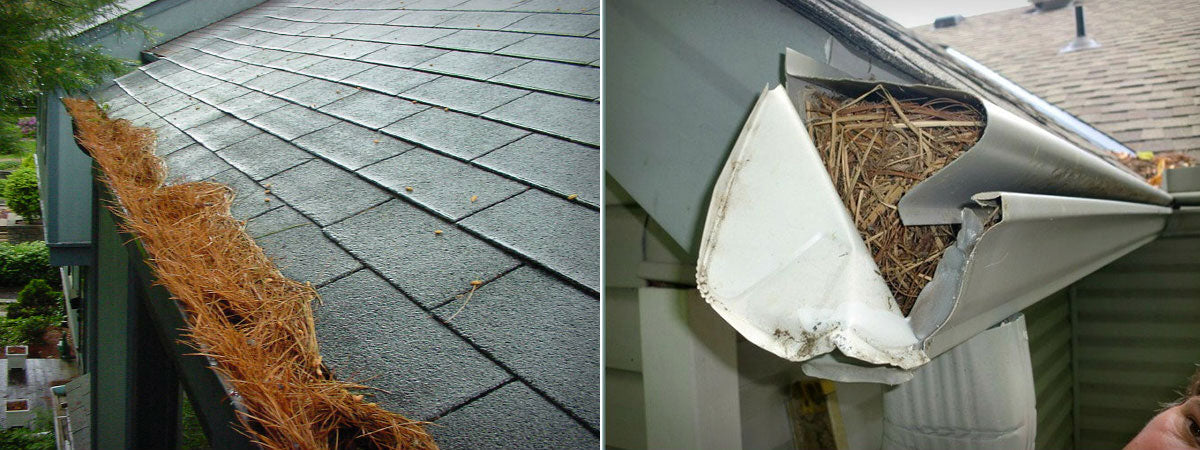
Pine needles mat together and pack into corners and downspout openings — the classic pine-tree clog.
How the brush handles pine needles
The bristles hold needles up in the brush, on top of and between the bristles, instead of letting them settle and mat at the bottom of the gutter. Because the needles are held apart rather than packed together, they can't form the dam that blocks water flow. Meltwater and rain flow through the brush and along the gutter to the downspout, even with needles resting on top. Needles on top of the brush dry out between rain events and much of the load blows away with the wind.
That is the whole mechanism, and it is also its limit: the needles don't vanish. Some stay caught in the bristles. That is the brush doing its job — holding debris where it can't dam the gutter — and it is why the brush is serviceable: lift a section out, shake the needles out, hose it off if needed, and slide it back in. No tools needed, and no part of the gutter has to be taken apart.

A customer in the mountains, three seasons under pine trees: needles stick up in the brush, and the gutters keep flowing.
Brush vs micro-mesh for pine needles — an honest comparison
| GutterBrush (brush) | Micro-mesh screen | |
|---|---|---|
| How it handles needles | Holds them in the bristles, apart, so they can't mat into a dam | Tries to keep them out; needles can lie flat on the mesh and stay put |
| Water flow in heavy rain | Water flows through the brush even with needles on top | Can shed water over the edge if the mesh surface is covered |
| Steep roofs / fast water | Holds up well — water is accepted through the bristles, not over a surface | Depends on the mesh staying clear |
| What maintenance looks like | Lift sections out, shake needles out, slide back in — no tools | Brush or hose the mesh surface clear; a matted layer can be harder to shift |
| Install | DIY — slides into the gutter | Usually professional install, screwed or clipped in place |
| When it is the better pick | Heavy pine load, steep roof, heavy rain, DIY install, gutters you can reach for a seasonal check | Light pine load where you want nothing visible sitting in the gutter, and you are happy to pay for professional install and surface cleaning |
If a homeowner's priority is keeping every needle out of sight and they don't want to lift brush sections out once or twice a season, a professionally installed mesh screen fits that preference better. GutterBrush is the better pick when the priority is keeping water flowing under a heavy needle load, in heavy rain, without a pro install. For a closer look at one micro-mesh system, see our Leaf Filter vs GutterBrush comparison.
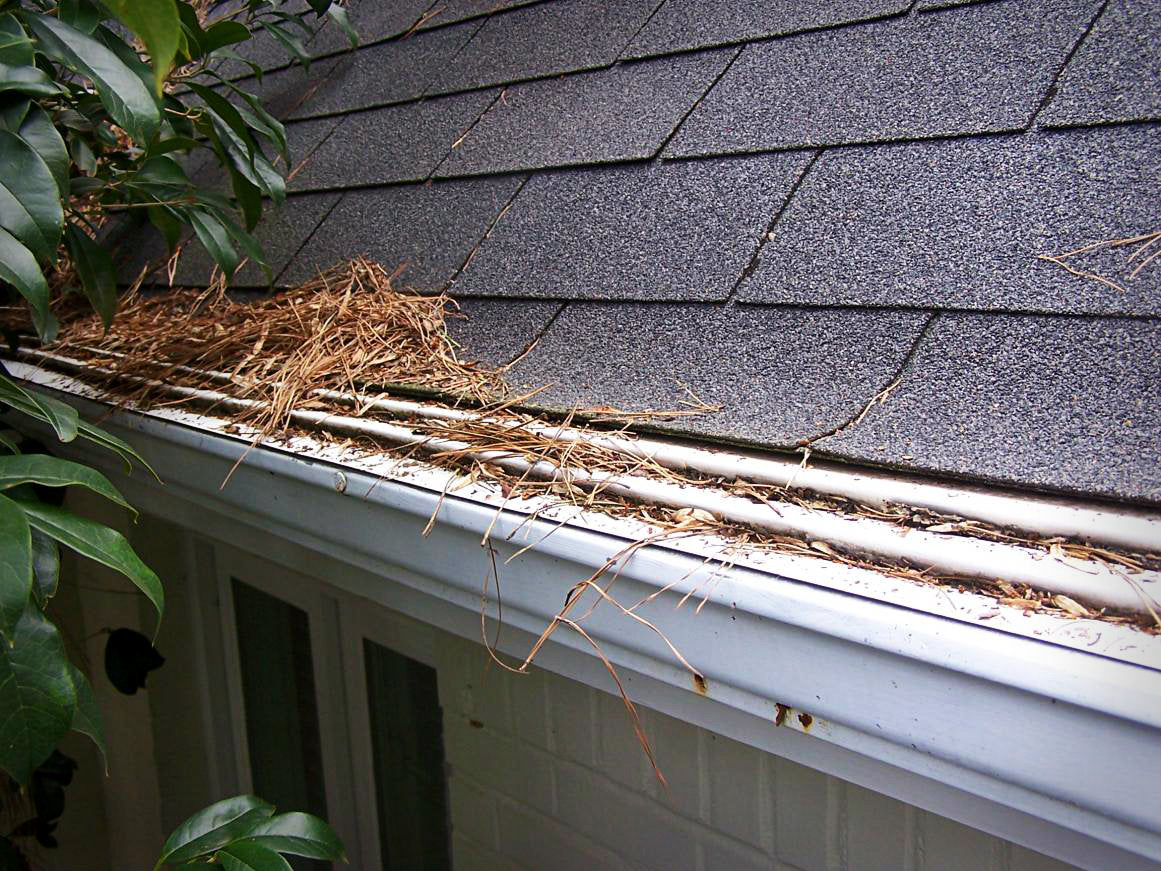
Needles don't always blow off a cover — they can mat on top of it, and a covered surface can shed water over the gutter edge in heavy rain.
What maintenance actually looks like
GutterBrush is not maintenance-free — no gutter guard is, under pine trees. The honest routine, once or twice a year in pine country (after the main needle drop, and again before winter):
- Lift a brush section out of the gutter.
- Shake the needles out over the ground, or hose the section off.
- Slide it back in. No tools, no fasteners to remove.
That is the whole job, and it is also the check: while a section is out, you can see the gutter bottom is clear. With a fixed screen, you can't see underneath it without removing it. To see it done, our GutterBrush maintenance guide shows a brush being cleaned after 4 years in the gutter.
Sizing for pine-tree homes
Pine needles don't change the sizing rule — size follows the gutter, not the tree. Each brush fits a K-style gutter 0.75" larger than the brush diameter, and the same-size squared gutter: 4.25" brush → 5" K-style / 4" squared; 5.25" → 6" K / 5" squared; 6.5" → 7" K / 6" squared. Six diameters cover gutters from 2.25" to 8.0". If you are unsure of your gutter size, the $19.95 sample pack (three sizes) is the low-cost way to confirm fit before ordering — and the free satellite measure gives a footage quote first.
Frequently asked questions
Will pine needles get stuck in the bristles?
Some will — that is how the brush works. The bristles hold needles where they can't pack together into a dam at the bottom of the gutter. Lift the section out, shake them out, and slide it back in.
Does GutterBrush keep pine needles out of the gutter?
No guard keeps every needle out, and GutterBrush doesn't claim to. It manages the needles that land there so they can't form a clogging dam, and water keeps flowing.
Is micro-mesh better for pine needles?
For keeping needles out of sight, mesh can be. For keeping water flowing under a heavy needle load in heavy rain, the brush has the advantage, because water flows through it even with needles resting on top. The right answer depends on what you value more — see the comparison table above.
How often do I need to clean it under pine trees?
Plan on once or twice a year — after the main needle drop and before winter. In a very heavy pine setting, a quick mid-season shake-out of the worst sections is worth it.